

If you’re looking to design and build a custom cable for a specific application, this article is for you. Whether you’re in defense, telecom, medical, or industrial automation, getting the right cable from the start can make or break your system’s performance. In this guide, we’ll walk you through the process of developing custom cables, from the initial design meeting to full-scale production, and explain why prototyping is essential for success. You’ll also learn what types of cables are available, why working with a USA-based manufacturer like Cables Unlimited gives you a clear advantage, and how to get your project started. Let’s dive in or contact our team now to get started on your custom cable solution.
What Is a Custom Cable?
A custom cable is a cable designed and manufactured to meet the specific needs of a unique application. Unlike standard off-the-shelf wires, a custom cable is built to exact specifications—including cable type, length, shielding, connectors, jacket materials, and electrical performance.
Companies choose a custom build when performance, space limitations, or environmental conditions require a solution that generic cables can’t provide. Whether it’s a medical device that demands flexibility and biocompatibility, or a military-grade communication system that requires EMI shielding and rugged durability, custom cable assemblies deliver precision and reliability.
Common use cases for custom cables include:
- Military and defense systems
- Medical imaging and diagnostic equipment
- Telecommunications infrastructure
- Robotics and industrial automation
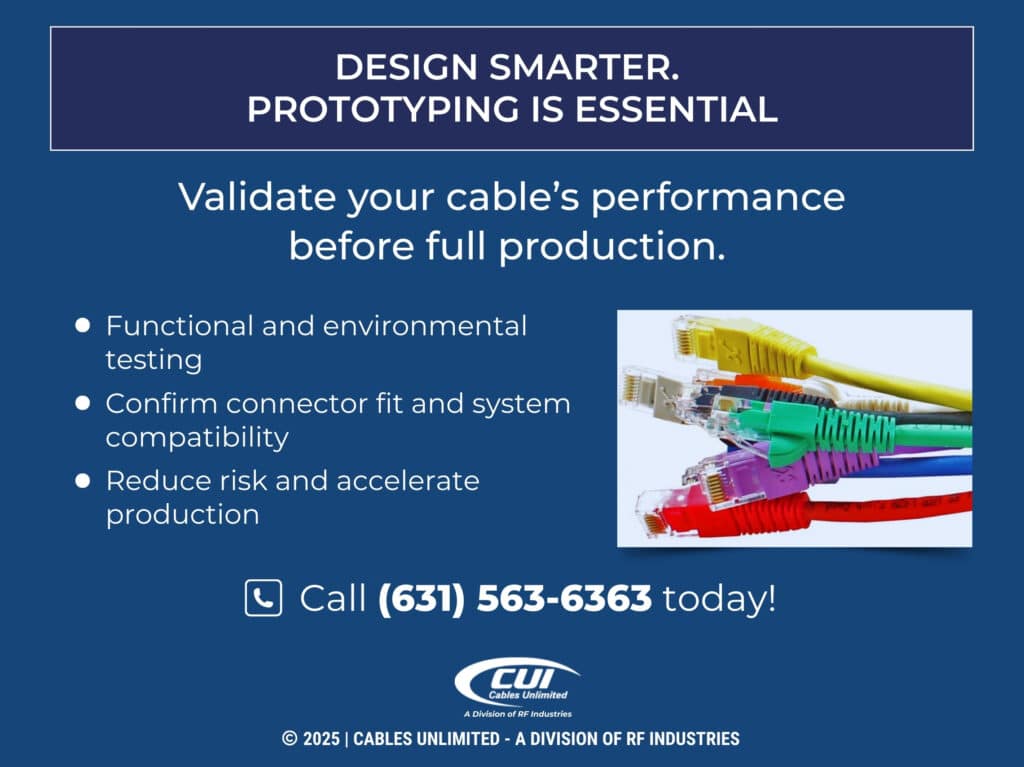

The Importance of Custom Cable Prototyping
Prototyping is the stage where a cable design is first built and tested. It allows engineers and clients to verify that the cable will meet their technical and physical requirements before committing to full-scale production.
Prototyping is essential because it helps identify and resolve issues early, saving time and reducing the risk of expensive redesigns. Here’s what prototyping helps validate:
- Cable length: Ensures proper fit within enclosures and along routing paths.
- Custom cable connectors: Confirms that chosen connectors are compatible with devices.
- Signal performance: Validates voltage ratings, impedance, EMI resistance, and data transmission integrity.
- Compatibility: Tests mechanical fit and function within the full system environment.
Step-by-Step Process of Custom Cable Development
From idea to production, cable development follows a well-defined process to ensure the cable meets all functional and compliance requirements.
Step 1 – Initial Design and Engineering
The process begins with understanding the client’s exact needs. This includes electrical specifications (voltage, current, impedance), environmental factors (temperature, moisture, and EMI), and mechanical constraints (bend radius, flexibility, and space requirements).
As cable creators, Cables Unlimited works directly with clients to capture these details and translate them into a clear design plan. CAD drawings and a bill of materials (BOM) are developed to outline every component.
Step 2 – Prototype Build and Testing
Once the design is approved, a prototype is assembled. This working sample is subjected to:
- Electrical testing: Continuity, resistance, shielding effectiveness
- Mechanical testing: Bend/flex cycles, abrasion resistance
- Environmental testing: Temperature, humidity, EMI/RFI exposure
This stage is especially important for custom RF cables, which must perform within tight frequency and shielding tolerances.

Step 3 – Design Revisions (if needed)
Based on test results, design adjustments may be necessary. These could include:
- Replacing or repositioning custom cable connectors
- Adjusting lengths or shielding
- Swapping materials to improve flexibility or reduce weight
Prototyping ensures these updates are implemented before major production investments are made.
Step 4 – Transition to Production
When the prototype meets all requirements, production begins. Cables Unlimited uses:
- Production-grade tooling for consistent assembly
- USA-based facilities for speed, compliance, and quality
- Final validation testing to guarantee reliability before shipment
Manufacturing in the USA supports better quality control, faster lead times, and easier client collaboration.
Types of Custom Cables We Build
Cables Unlimited designs and manufactures a wide range of cable assemblies, including:
- Custom wire harnesses for automotive and robotics
- Custom RF cables for telecom and wireless
- Custom cable connectors and assemblies tailored for each system
- Fiber optic and hybrid cable solutions for high-speed data and power delivery
Why Choose a USA-Based Custom Cable Manufacturer
Choosing a domestic custom cable manufacturer offers significant advantages:
- Faster communication: Work directly with engineers and support teams
- Better supply chain control: Avoid international shipping delays and tariffs
- Compliance confidence: Adherence to MIL-SPEC, UL, RoHS, and ISO standards
- Built-in expertise: U.S. manufacturers offer engineering insight from prototype to final build
How Fast Can Custom Cable Assemblies Be Produced in the USA?

How to Start Your Custom Cable Project
To start your project, be ready to share:
- Electrical and mechanical specs
- Operating environment (temperature, EMI, etc.)
- Device compatibility and connector preferences
Cables Unlimited acts as your custom cable creator, helping with design consultation, prototyping, and scalable production. You can contact us or request a quote online to begin your cable project in the USA.
Final Thoughts on Custom Cable Development
Designing a custom cable involves more than just choosing wires and connectors. It requires careful planning, precise prototyping, material selection, and coordination with a trusted manufacturing partner. Prototyping ensures performance, compatibility, signal integrity, and long-term reliability, while U.S.-based production delivers faster results, consistent quality, and adherence to higher industry standards. Ready to get started? Contact Cables Unlimited now and make your custom cable vision a reality.


